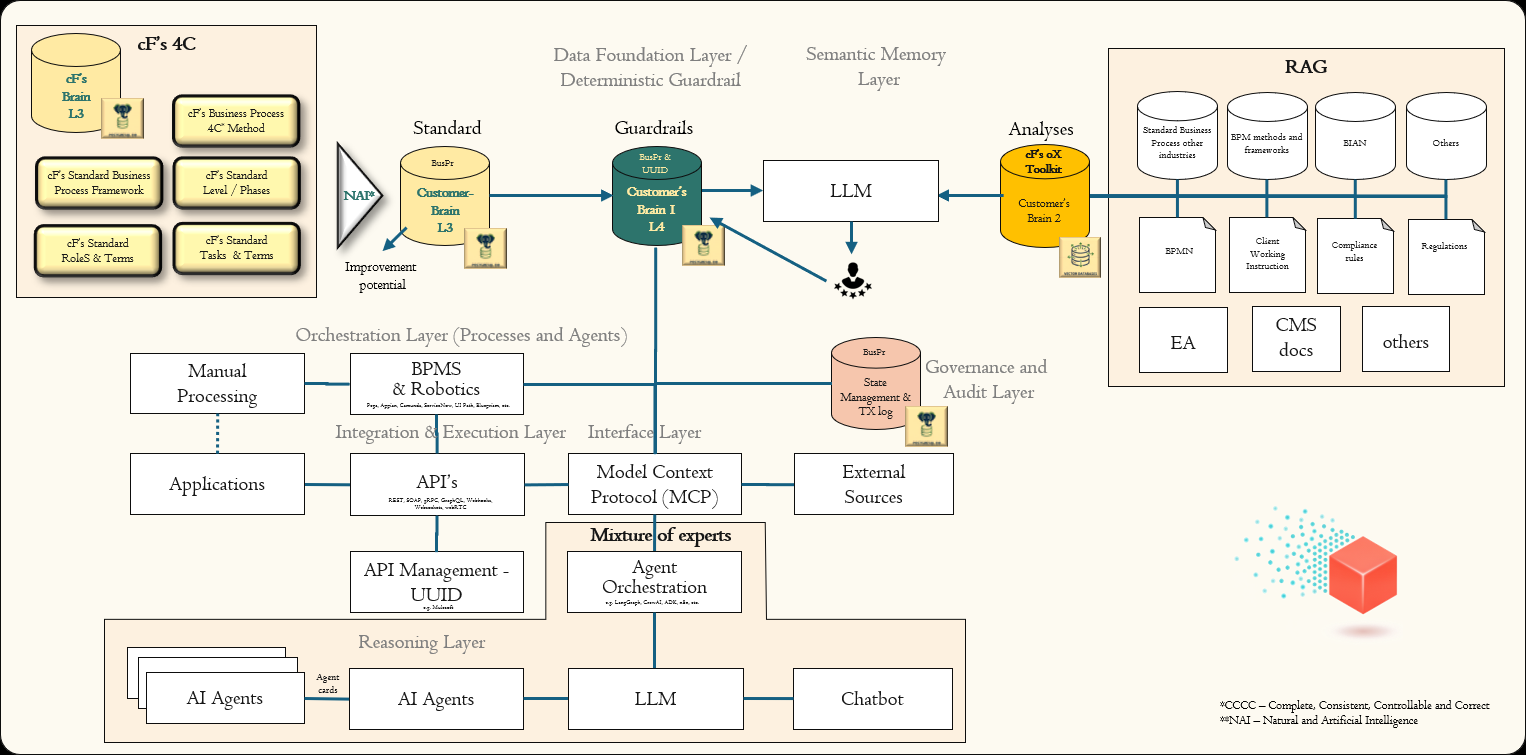
cF Architecture
Highly isolated layers.
The cogniFactum architecture is built from the following highly isolated layers:
Build Phase
From activity (L3) to task (L4)
The customer’s processes are first captured at activity level (L3), based on cF’s standard process repository (cF’s Brain), and then enriched to task level (L4). The result is the rational Customer’s Brain 1.
Deterministic Guardrails
Level 4 – Customer’s Brain 1 Rational
The foundation of the architecture is a relational PostgreSQL database. It holds the customer’s operating model with all roles, phases, activities (L3) and atomic tasks (L4) according to the “4C standard” (Complete, Consistent, Compliant, Correct) – plus, for every task, references to the documents, templates, APIs and data sources it uses. The content of these objects is not stored here; it remains in the respective management systems (e.g. document management, API management). This layer acts as a hard guardrail that prevents AI agents from “inventing” processes (hallucinations).
Semantic Memory
Level 4 – Customer’s Brain 2 Analytical
The content of the documents, templates, APIs and data sources referenced in Customer’s Brain 1 is made available for AI analysis – either indexed in a vector database or retrieved directly from the source systems (e.g. document management, API management) via RAG. The source systems remain the owner of the content. The Large Language Model (LLM) uses this knowledge as a “cognitive analyst”.
The Deterministic Bridge
UUID Filtering
Every task in Customer’s Brain 1 carries a UUID (Universally Unique Identifier) that serves as a strict metadata filter. When retrieving knowledge, an AI agent may only access the content in Customer’s Brain 2 that is linked to the UUID of the task currently being executed.
Orchestration & Integration
BPMS, Agents & MCP
The processes defined in Customer’s Brain 1 are executed by a BPMS with robotics (e.g. Camunda, Pega), which also orchestrates AI agents within defined process steps. Where no BPMS is in place, or for agent work outside defined processes, a standalone multi-agent framework (such as LangGraph or n8n) can be connected. Communication with enterprise APIs runs centrally via the Model Context Protocol (MCP), which acts as a standardized translator and security hub.
Compliance & Read-Only Principle
Human-in-the-Loop
Generative AI models never receive direct write access to the deterministic process database (Customer’s Brain 1 – read-only). Instead, change proposals are generated that must be approved according to the “human-in-the-loop” principle. In addition, every system decision is logged in an audit-proof manner in an immutable State Management & TX log.
cogniFactum AI Platform Architecture
Build phase
cF’s Brain
L3 · 4C standard repositoryCustomer’s Brain L3
L3 · activitiesCustomer’s Brain L4
L4 · tasks + referencesTwo Brain concept
Customer’s Brain L4 Rational
Rational Brain · L4 · deterministic- PostgreSQL
- Roles · phases · activities · tasks
- References: documents, templates, APIs, data sources
- 4C standard
LLM / AI agents
AnalysisHuman-in-the-Loop
Approval before any change to Customer’s Brain 1Customer’s Brain L4 Analytical
Analytical Brain · L4 · RAG- BPMN
- Work instructions
- Compliance rules
- Regulations
- Enterprise architecture
- CMS documents
- Standard processes of other industries
- BIAN
Indexed in a vector database or retrieved live from the source systems
Execution & governance
Orchestration
- BPMS & robotics (e.g. Camunda, Pega)
- AI agents within defined process steps
- Agent framework (optional, via MCP)
Integration
- Model Context Protocol (MCP)
- Enterprise APIs · API management
- Applications
- Manual processing
- External sources
Governance & Audit
- State Management & TX log
- Immutable · audit-proof
- Read-only for GenAI
cogniFactum AI Platform Architecture – detailed view